
Kari Lilja, TkT, Erikoistutkija; Sirpa Sandelin, TkT, Yliopettaja
English version: click the link
Edellisessä blogissani kerroin, kuinka ammatilliseen koulutukseen pyrkivien nuorten määrä laski kaikkialla muualla, paitsi Etelä-Pohjanmaalla. Selitykseksi tarjottiin lukio- ja korkea-asteen kiinnostavuuden kasvua. Aloin kuitenkin pohtia, josko tässä näkyisi ikäluokkien pienenemisen vaikutus, joka tällä hetkellä jo alkaa näkyä peruspetukseen tulevien määrissä. Mietin, että vastaus saattaisi löytyä tilastoista.
Tilastokeskus julkaisi 28.5.2026 tiedotteen, jonka mukaan ammatillisen koulutuksen opiskelijoiden määrä väheni 28 900 opiskelijalla vuonna 2025. Ammatilliseen koulutukseen tulleiden uusien opiskelijoiden osuus tästä vähennyksestä oli merkittävä: Uusia opiskelijoita oli 22 000 vähemmän kuin vuonna 2024.
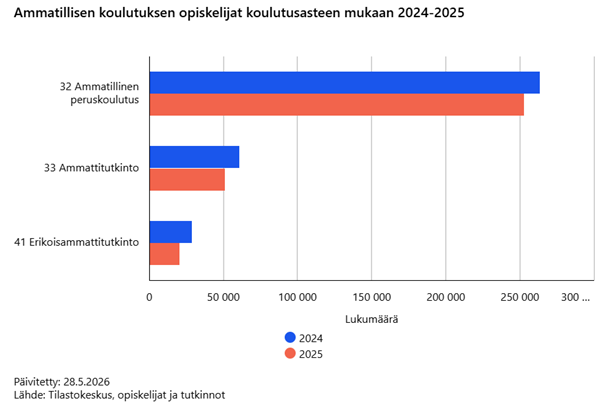
Source: www.stat.fi Ammattiin opiskelevat ja tutkinnot
Tilastokeskuksen laatiman väestöennusteen mukaan 15-24 vuotiaiden määrän kulminaatiopiste olisi vuonna 2030. Ikäluokan, joka todennäköisimmin opiskelee lukioissa ja ammatillisissa oppilaitoksissa (ja ammattikorkeakouluissa) määrä on tuolloin korkeimmillaan ja kääntyy sitten laskuun. Parin totutteluvuoden jälkeen lasku onkin sitten aika jyrkkää aina vuoteen 2041 saakka. Kehitys on sama koko maassa ja Satakunnassa. Käytännössä se tarkoittaa sitä, että ainakin perustutkintojen koulutuspaikkojen tarve pienenee 2030-luvulla huomattavasti. Ammatinvaihtajia kun tuskin on niin paljoa, että koko nykyistä ammatillisen koulutuksen verkostoa on järkevää ylläpitää. Edessä on siis yhteensulautumisia tai radikaaleja leikkauksia ja erikoistumista
Meillä Satakunnassakin on tällä hetkellä kaksi isoa ammatilliseen koulutukseen keskittyvää instituutiota.
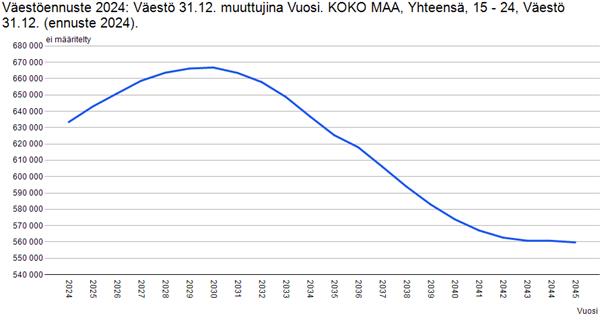
Source www.stat.fi: 14wx — Väestöennuste 2024: Väestö iän ja sukupuolen mukaan alueittain, 2024-2045
Mielenkiintoisimman havainnon, ainakin WIN4SME:n Suomen CoVEn teemojen kannalta, tein kuitenkin, kun laajensin grafiikkaa ottamalla mukaan vanhemmatkin ikäluokat. Yhtenä teemanamme on ”Silver workforce”, eli ikäluokat 55-64 ja siitä ylöspäin. Näistä ikäluokista työvoimareservin kannalta tärkein, juuri eläkkeelle jääneet eli 65-74 vuotiaat, näyttäisi aluksi pienenevän vuoden 2030 jälkeen ja lähtevän uuteen kasvuun vasta vuoden 2040 paikkeilla. Todellinen reservi näyttäisikin siis olevan yli 75-vuotiaissa.
Ainakin jos katsotaan pelkkiä määriä.
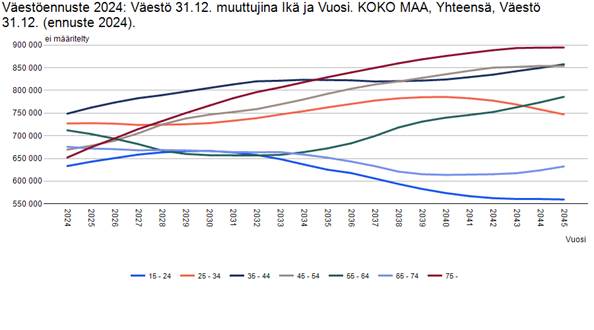
Source www.stat.fi: 14wx — Väestöennuste 2024: Väestö iän ja sukupuolen mukaan alueittain, 2024-2045
Kun samanaikaisesti tiedetään, että muistisairauksien ja muiden terveysongelmien määrä voi kasvaa kaksinkertaiseksi vuoteen 2040 mennessä (K. Korhonen, 28.6.2026), voidaan hyvällä syyllä miettiä, miten suuri osuus tästä vanhimmasta kohortista on todella potentiaalista työvoimaa, ja miten koko silver workfrocea parhaiten pystyisi hyödyntämään. Jos vaihtoehtona ovat uusille aloille ja uusiin tehtäviin kouluttaminen, vanhojen oppien vahvistaminen ja kertaaminen tai oppien ja kokemusten taltiointi ja jakaminen, minusta ainakin kaksi viime mainittua ovat edes realistisia.
Jopa koko silver-kohorttia ajatellen.
Tämän tekstin on samalla tarkoitus osoittaa, että analyysi ja evaluointi ovat todella jotain muuta, kuin kauniiden värikkäiden piirakoiden tulostamista. Se on asioiden syiden, taustojen ja seurausten pohtimista, lukujen taakse kurkistamista ja numeroiden avaamista yleistajuisiksi selvityksiksi eri ilmiöistä.
Jos sitä ei tee, ei tee mitään.
In English
Brain activity – in vacation? 2026 b
In my previous blog, I told how the number of young people seeking vocational education decreased everywhere else, except in South Ostrobothnia. The explanation offered was the increase in interest in upper secondary and higher education. However, I began to wonder whether this was due to the effect of the shrinking age groups, which is currently already starting to be seen in the number of people entering basic education. I thought that the answer might be found in the statistics.
On 28 May 2026, Statistics Finland published a press release stating that the number of vocational education students decreased by 28,900 students in 2025. The share of new students entering vocational education in this decrease was significant: There were 22,000 fewer new students than in 2024.
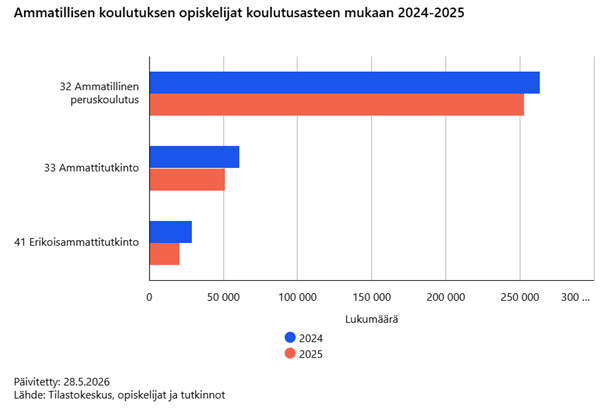
Students of vocational training: 32= Initial vocational training, 33 = Vocational qualification, 41 = Further vocational qualification. Source: www.stat.fi Vocational students and qualifications
According to the population forecast prepared by Statistics Finland, the culmination point for the number of 15-24 year olds would be in 2030. The number of the age group that is most likely to study in upper secondary schools and vocational schools (and universities of applied sciences) will be at its highest at that time and then start to decline. After a couple of years of adjustment, the decline will be quite steep until 2041. The development is the same throughout the country and in Satakunta. In practice, this means that the need for at least basic education places will decrease significantly in the 2030s. There are hardly so many career changers that it makes sense to maintain the entire current vocational education network. So we are facing mergers or radical cuts and specialization
We have two large institutions in Satakunta too that currently focus on vocational education.
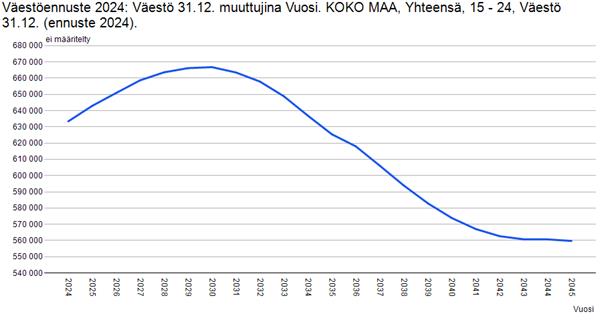
Source www.stat.fi: 14wx — Population forecast 2024: Population by age and sex by region, 2024-2045; Region = Whole country (Finland), age group 15 -24, Total.
However, the most interesting observation, at least in terms of the themes of CoVE Finland of project WIN4SMEs, was when I expanded the graphic to include older age groups. One of our themes is the ”Silver workforce”, i.e. age groups 55-64 and above. Of these age groups, the most important cohort in terms of the labour reserve, those who have just retired, i.e. 65-74 years old, would seem to initially decrease after 2030 and only start to grow again around 2040. The real reserve would therefore seem to be in those over 75 years old.
At least if we look at the numbers alone.
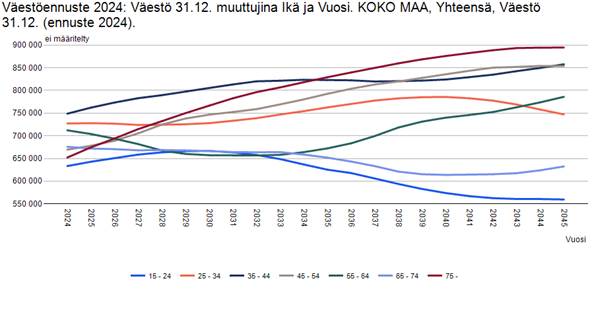
Source www.stat.fi: 14wx — Population forecast 2024: Population by age and sex by region, 2024-2045; Region = Whole country (Finland), age groups from 15 -24 to 75 +, Total.
When we simultaneously know that the number of memory disorders and other health problems among the oldest age groups may double by 2040 (see e.g., K. Korhonen, 28.6.2026), we can with good reason wonder how large proportion of this oldest cohort is actually a potential workforce, and how the entire silver workforce could best be utilized. If the alternatives are training for new fields and new tasks, reinforcing and reviewing old lessons, or recording and sharing lessons and experiences, I that only the last two mentioned are at least realistic.
Also when considering the entire silver cohort.
In addition to discuss vocational education and silver workforce, this text was also intended to show that analysis and evaluation are really something other than printing beautiful colourful pies. It is about considering the causes, backgrounds and consequences of things, looking behind the numbers and opening the numbers to common sense explanations of various phenomena.
If you don’t do it, you don’t do anything.
Tämä blogikirjoitus on kirjoitettu Euroopan unionin osarahoittaman Win4SMEs-hankkeen puitteissa. Näkemykset ja mielipiteet ovat kuitenkin ainoastaan kirjoittajan/kirjoittajien omia eivätkä välttämättä vastaa Euroopan unionin tai Euroopan koulutuksen ja kulttuurin toimeenpanoviraston (EACEA) näkemyksiä. Euroopan unionia tai EACEA:ta ei voida pitää niistä vastuussa.
This blog text has been written within the framework of project WIN4SMEs, co-funded by the European Union. Views and opinions expressed are however those of the author(s) only and do not necessarily reflect those of the European Union or the European Education and Culture Executive Agency (EACEA). Neither the European Union nor EACEA can be held responsible for them.
